Understanding the Australian Disaster Relief Fund Schedule for Deductible Gift Recipient Applicants
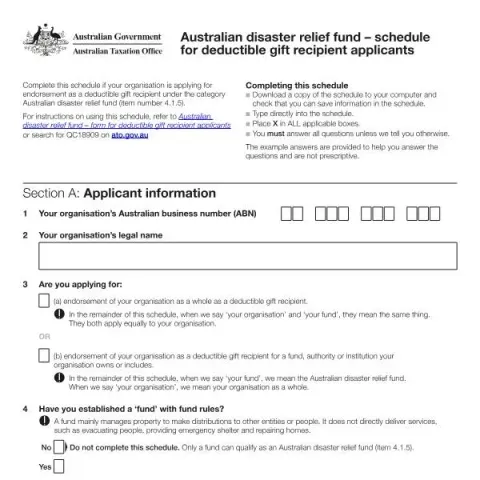
The Australian Taxation Office (ATO) has released a specific schedule, NAT 15609, designed to assist organisations seeking endorsement as a deductible gift recipient (DGR) under the Australian disaster relief fund category. This schedule is a crucial part of the application process for charities or entities that aim to be recognised for tax-deductible donations related to disaster relief efforts in Australia.
Purpose and Scope of the Schedule
This form is intended solely for organisations applying for endorsement as a DGR under the Australian disaster relief fund (item number 4.1.5). It helps the ATO verify that the applicant organisation meets the legal and operational criteria necessary to qualify for this specific endorsement. The schedule is part of a broader application process, which includes submitting supporting documentation and demonstrating compliance with relevant legal and operational standards.
Who Should Complete This Schedule?
Only organisations that are applying for endorsement as a DGR under the disaster relief fund category need to complete this schedule. This includes:
- Registered charities seeking recognition for disaster-related donations.
- Organisations that have established a fund with specific rules aimed at managing disaster relief resources.
If your organisation operates a fund that manages property or makes distributions to other entities, and does not directly deliver services such as emergency shelter or evacuation, then this schedule is relevant. Conversely, if your organisation does not meet these criteria, you should not complete this form.
Key Sections of the Schedule
Section A: Applicant Information
This section requires details such as your organisation’s legal name, Australian Business Number (ABN), and whether you are applying for endorsement of your organisation as a whole or for a specific fund. You will also need to provide your organisation’s objects or purposes as outlined in your governing documents, ensuring they align with disaster relief activities.
Section B: Disaster Details
The schedule asks whether the disaster in question is listed on the ATO’s official list of disasters (accessible via the ATO website). If the disaster is listed, you will need to specify the name and details. If not, you must provide information about the disaster’s location, the declaration date, and the minister responsible for declaring the disaster.
Section C: Relief Activities
This part requires an explanation of how your organisation will ensure that the funds are used solely for relief efforts related to the disaster. The ATO emphasizes the importance of demonstrating that the funds will be directed towards assisting people in distress due to the disaster, including community re-establishment efforts.
Section D: Organisational Status
You must declare whether your organisation is a government agency or a registered charity. Only entities that are either government agencies or registered charities, or operated by such, qualify to be endorsed under this category.
Fill in your form directly online
No printing: type your details into the boxes of the official form, tick, then download the PDF ready to send.
- 1Type into the form boxes
- 2Tick in one click
- 3Save and download the PDF
Important Points for Applicants
- You should download and save a copy of the schedule to your computer before completing it, ensuring you can enter your information directly into the form.
- All applicable boxes must be marked with an X, and all questions should be answered unless instructed otherwise.
- Provide detailed and accurate information, especially regarding the disaster event and your organisation’s objects.
- Ensure your governing documents clearly define the disaster and outline your organisation’s relief objectives, as this will support your application.
Submitting the Schedule
The completed schedule is typically submitted online via the myGov platform, linked to the ATO’s online services. It is essential to ensure that all sections are thoroughly completed and that supporting documentation, such as governing documents and evidence of disaster declaration, are available if requested.
Conclusion
The NAT 15609 schedule provides a structured way for organisations involved in disaster relief to formalise their application for DGR endorsement. By carefully completing this form and demonstrating compliance with the criteria, organisations can enhance their eligibility to receive tax-deductible donations, thereby supporting their vital work in disaster-affected communities across Australia.