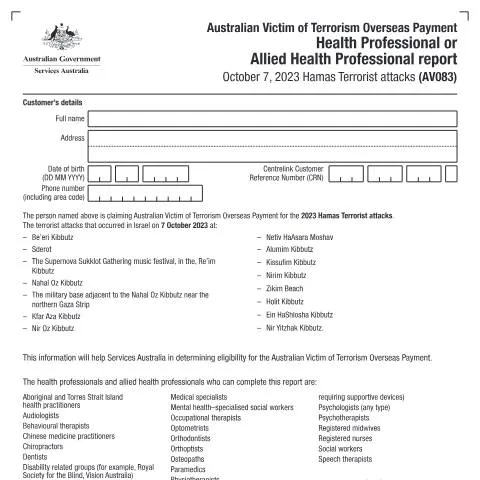
Understanding the Context of the AV083 Form
The October 7, 2023 Hamas Terrorist Attacks - Australian Victim of Terrorism Overseas Payment Health Professional or Allied Health Professional Report, commonly referred to by its code AV083, emerges from a critical need to address the aftermath of international terror incidents impacting Australian citizens abroad. This document serves a pivotal role within the framework established by the Australian government to provide support and resources to victims affected by terrorism.
In light of the increase in global security threats and the inherent risks taken by Australian citizens traveling overseas, the Australian government, through Services Australia, has instituted various measures to support those who find themselves victims of terrorism. This form, therefore, is not merely a bureaucratic tool; it embodies the government’s commitment to assisting its citizens in crises.
Who is Required to Submit AV083?
Specific criteria govern who can submit the AV083 form. Primarily, this document is intended for health professionals involved in the care of Australian citizens who have been victims of terrorist acts while outside the country. These professionals could be a general practitioner, a psychologist, or any allied health worker providing support and treatment.
- Australian Citizens: Those who were injured or affected by the terrorist attacks while traveling abroad.
- Health Professionals: Individuals tasked with providing necessary medical documentation to validate the circumstances surrounding the victim's health status.
- Allied Health Professionals: Including but not limited to physiotherapists, occupational therapists, and social workers who have rendered support post-incident.
Navigating the Form’s Specifics: Key Sections Explained
Understanding each component of the AV083 form is instrumental in ensuring accurate completion. Here, we delve into the critical sections of the form and highlight potential areas of confusion.
Section A: Victim's Identification
This initial section is crucial as it establishes the identity of the victim. Ensure that the full name, date of birth, and contact information are filled out accurately. A common error here includes mismatching names as they appear in identification documents.
Section B: Incident Details
In this part, the health professional is required to detail the circumstances surrounding the terrorist act. Specific questions may pertain to the date, location, and nature of the incident. It is vital to provide concise and factual information, as embellishments or inaccuracies can lead to delays or denials in processing.
Section C: Medical Information
This section demands a comprehensive overview of the victim’s injuries or health issues resulting from the incident. Health professionals must be precise in describing the nature of the injuries, treatments provided, and any ongoing conditions. Make sure to include specifics about medical interventions, timelines of treatment, and projected recovery plans.
Documentation and Evidence Required for Submission
Completing the AV083 form is merely one aspect of the submission process. Accompanying documentation plays a pivotal role in supporting the claims made within the form.
- Medical Reports: A detailed report from the health professional that outlines the medical condition of the victim and the treatments administered.
- Identification Proof: Copies of identification documents, such as a passport or driver's license, to confirm the identity of the victim.
- Incident Documentation: Any police reports or news articles related to the incident can reinforce the validity of the claim.
It is advisable to collate all documents meticulously to prevent any oversight that could hinder the process.
The Procedural Path: Where AV083 Fits In
Submitting the AV083 form is not an isolated event; it is part of a larger procedural framework. Understanding this context is essential for both victims and health professionals.
When a health professional submits the AV083 form, it enters a specific review process managed by Services Australia. This involves:
- Initial Assessment: The documentation is reviewed for completeness and accuracy by Services Australia.
- Further Clarifications: If necessary, additional information may be requested from the health professional or the victim.
- Decision Notification: Once assessed, a decision regarding the eligibility for the Terrorism Overseas Payment is communicated to the victim.
Submission Channels: Options for Sending AV083
Understanding the available channels for submitting the AV083 form can facilitate a smoother process. The options include:
| Submission Method | Details | Pros | Cons |
|---|---|---|---|
| Online via myGov | Submission through the myGov portal linked to Services Australia | Quick processing, secure | Requires a myGov account |
| Paper form sent to the designated Services Australia address | Accessible to those without online capabilities | Longer processing time | |
| In-person | Submission at a local Services Australia office | Immediate confirmation of receipt | Travel may be required |
After Submission: What to Expect
Once the AV083 form has been submitted, the next steps involve a waiting period while Services Australia processes the request. During this time, it is essential to keep lines of communication open.
- Tracking Your Submission: If submitted online, tracking updates may be available through your myGov account.
- Follow-Up Queries: Be prepared to respond to any queries from Services Australia, as prompt replies can expedite the process.
- Final Decision: The victim will receive a formal notification regarding the outcome of their claim, detailing any applicable benefits or payments.
Understanding the timeline and potential outcomes can help manage expectations in what is often a trying time for victims and their families.
Additional Resources and Support Channels
Filing the AV083 form can be daunting, especially for those who have just experienced a traumatic event. Various resources are available to assist both victims and health professionals:
- Services Australia Helpline: A dedicated service for queries related to the AV083 process.
- Victim Support Services: Numerous organizations provide psychological support and guidance for victims of terrorism.
- Legal Assistance: In cases where there are disputes regarding claims, legal aid may be available to help navigate the process.
Leveraging these resources can prove invaluable during the completion of the AV083 form and the subsequent steps.
Final Thoughts on Completing the AV083 Form
Completion of the AV083 form signifies an important step towards accessing support available to victims of terrorism. The process can be intricate, but with the right information, resources, and careful attention to detail, health professionals and victims can successfully navigate the requirements laid out by Services Australia.
Staying informed and proactive throughout the submission and processing stages is crucial in ensuring that the benefits intended for victims are accessible when they need them the most.
Understanding the Australian Victim of Terrorism Overseas Payment
The Australian Victim of Terrorism Overseas Payment (AVTOP) is a vital support mechanism for Australians who suffer harm as a result of terrorist acts overseas. Introduced to provide financial assistance, the AVTOP is designed to alleviate some of the immediate financial burdens faced by victims and their families. This payment is crucial for covering medical expenses, psychological care, and other associated costs that arise from such traumatic events.
To be eligible for the AVTOP, applicants must meet specific criteria, including being an Australian citizen or permanent resident at the time of the attack. The incident must be recognized as a terrorist act by the Australian Government, and the victim must have sustained injuries or suffered a significant mental health impact due to the event. It's essential to gather extensive documentation to support your claim, which includes police reports, medical records, and any relevant insurance information.
When applying for the AVTOP, individuals will need to submit a formal application through the Department of Foreign Affairs and Trade (DFAT). The process emphasizes transparency and thorough consideration of each case, allowing victims to access the supports they need as quickly as possible. Furthermore, the decision-making is grounded in the Administrative Decisions (Judicial Review) Act 1977 (Cth), ensuring that victims have the right to seek a review of decisions through the Administrative Appeals Tribunal (AAT) if necessary.
The Role of Health Professionals in Supporting Victims
Health professionals play a crucial role in the recovery process for victims of terrorism. Their expertise is not only paramount in providing immediate medical care but also in supporting the long-term psychological healing of these individuals. Allied health professionals, including psychologists, social workers, and occupational therapists, are integral in delivering the necessary support services that victims require.
When a victim applies for the AVTOP, they often need a detailed report from a registered health professional. This report should outline the nature of the injuries sustained, the impact on the person's overall health, and the ongoing treatment plan. It is essential for health professionals to create comprehensive and precise assessments to aid victims in securing their benefits. The report must detail both physical and mental health aspects, highlighting any long-term effects that may warrant additional support or ongoing treatment.
Additionally, health professionals should be aware of the specific terms and conditions attached to the AVTOP, as these can influence the type of care and documentation required. Understanding the nuances of this program means that health professionals can provide victims with tailored advice, enabling them to navigate their recovery more effectively.
Community Support and Resources for Victims
The aftermath of a terrorist attack can leave victims and their families feeling isolated and overwhelmed. Community support plays an essential role in the recovery journey, providing emotional, social, and practical assistance. Various organizations and support groups are available to offer resources, counseling, and advocacy for victims of terrorism in Australia.
Local community centers often provide support networks where victims can connect with others who have experienced similar trauma. These networks can be invaluable for emotional healing and provide a safe space for individuals to share their experiences and coping strategies. Moreover, many organizations offer workshops and seminars focused on trauma recovery, resilience building, and mental health awareness, facilitating a greater understanding of the psychological impacts of terrorism.
In addition to peer support, there are numerous resources available from government bodies and non-profit organizations dedicated to helping victims of terrorism. For instance, the Australian Red Cross offers a range of services, including crisis support and recovery programs, while Services Australia can assist with navigating the financial aspects, including the AVTOP application process.
Furthermore, online platforms such as myGov can serve as a resource for connecting victims with relevant services and streamlining the application processes for various types of support. Victims should be encouraged to reach out for help and to utilize these community resources to support their recovery journey effectively.