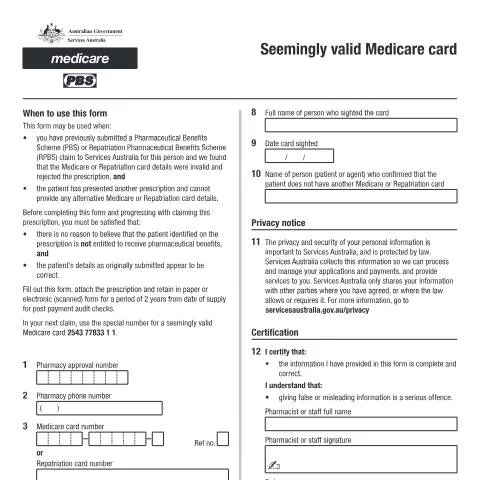
Unlocking Access to Healthcare: Understanding the Seemingly Valid Medicare Card Form (PB136)
Imagine you are a recent immigrant to Australia, eager to access the healthcare system but feeling overwhelmed by the necessary paperwork. The first step on this journey involves a crucial document: the Seemingly Valid Medicare Card Form, known officially as PB136. This form serves as a stepping stone towards obtaining vital healthcare services in Australia. To navigate this terrain smoothly, it is essential to understand the intricacies surrounding this document, from who needs it to how to fill it out effectively.
Who Seeks this Form and Why: Real-World Scenarios
The PB136 form is predominantly utilized by individuals who require verification of their Medicare eligibility. Various scenarios necessitate its completion:
- Permanent Residents: Those newly granted permanent residency often need to establish their Medicare status, making this form essential.
- Foreign Students: International students enrolled in approved Australian educational institutions may also apply for a Medicare card, requiring the PB136 for processing.
- Temporary Visa Holders: Some temporary visa holders may be eligible for Medicare, but they must submit this form to confirm their status.
- Newborns: Parents wishing to register their newborn for Medicare must also fill out this form as part of the process.
The Role of PB136 in the Bigger Picture
Understanding where the PB136 fits into the larger context of Australian healthcare is imperative. This form is not just a stand-alone document; it is part of a broader administrative framework that connects various health services to citizens and residents. When you submit PB136, you are initiating a process that allows you to access subsidized health services, from general practitioner (GP) visits to hospital treatments.
Once submitted, this form is reviewed by Services Australia, which assesses your eligibility for Medicare benefits based on the details provided. Without completion of this form, an individual may face delays or denials in accessing essential healthcare services.
Decoding the PB136: Section by Section
When it comes to completing the PB136 form, each section requires careful attention. The following breakdown highlights what information is needed in each part of the form, along with common pitfalls to avoid:
Personal Information
In this section, applicants must provide their full name, address, date of birth, and other pertinent details. It is crucial to ensure that the information matches official identification documents. Common mistakes include:
- Misspellings in the name.
- Incorrect address details.
- Discrepancies in date of birth compared to legal documents.
Visa Details
For individuals on temporary or specific visas, providing the correct visa subclass is vital. This section often trips up applicants, particularly those unfamiliar with their visa classifications. Reference your visa grant notice to avoid errors.
Health Information
Here, you may need to disclose any pre-existing health conditions. This section is critical for Services Australia to assess the risk and provide appropriate coverage. Be honest and thorough to avert issues later on.
Emergency Contact Details
Including an emergency contact is a good practice. Ensure the contact is someone who is reachable and willing to assist if necessary. Providing an incorrect phone number could lead to delays in communication.
Gathering Supporting Documentation
Completing the PB136 form is only part of the process. You will also need to gather supporting documents to validate the information provided. Here are some common documents required:
| Document Type | Required for | Notes |
|---|---|---|
| Birth Certificate | All applicants | Must be an original or certified copy. |
| Visa Grant Notice | Temporary visa holders | Confirm your visa subclass. |
| Proof of Residency | Permanent residents | Utility bills or lease agreements are acceptable. |
Navigating the Submission Process: Channels and Methods
Once the PB136 form is completed and all documents are in order, the next step is submission. Depending on your preferences, you have several options:
- Online Submission: If you have a myGov account linked to Services Australia, you can submit the form electronically. This is often the fastest method.
- In-Person Submission: For those who prefer face-to-face interactions, visiting a Services Australia service centre is an option. Be sure to bring all original documents.
- Postal Submission: While not the most efficient, you can mail your completed form and documents. It is advisable to use registered post for tracking.
Timelines for Processing
From the moment your form is submitted, the processing time can vary. Typically, online submissions are processed more quickly than those sent through postal services. Always check with Services Australia for estimated timelines related to your specific case.
Addressing Challenges: What If Issues Arise?
Facing a delay or a refusal can be disheartening. If your application for a Medicare card is rejected, you have avenues to explore:
- Requesting a Review: If you believe the decision was incorrect, you can request a review from Services Australia. This involves providing additional information or clarification.
- Updating Documentation: Sometimes, the issue stems from incomplete or inaccurate documents. Double-check your submissions and provide missing information promptly.
- Seeking Help: If the process becomes overwhelming, consider reaching out to community organizations or legal services that specialize in immigration and health access.
Special Circumstances: Unique Situations that Require Attention
There are cases where filling out the PB136 form may involve complexities:
Minors and Guardianship
For minors, the form must be submitted by a parent or legal guardian. Ensure that all required permissions and documentation proving guardianship are included to avoid delays.
Emergency Situations
If you find yourself in a medical emergency and do not yet have a Medicare card, you can still receive treatment. It is advised to inform the healthcare provider that you are in the process of obtaining your card and show your completed PB136 form.
Documentation for Non-Citizens
Non-citizens may encounter additional requirements based on their visa status. Always refer to the specific visa conditions to ensure compliance when filling out PB136.
Final Steps: What Happens Next?
After submitting your PB136 form and gathering the necessary documentation, the wait begins. You will be notified of your application status through your preferred communication method. If approved, your Medicare card will arrive in the mail, providing access to vital health services.
In the event of approval, remember to keep your card safe and inform your healthcare providers of your Medicare status. Regular updates or renewals may also be necessary, especially if circumstances change, such as a change in residency status or visa. Always stay informed of your rights and responsibilities as a Medicare cardholder.
Understanding the Seemingly Valid Medicare Card Form (PB136)
When navigating the complexities of Australia’s healthcare system, understanding the Medicare card application process is essential. The seemingly valid Medicare card form, known as PB136, plays a crucial role in this process. This form is primarily used to apply for a Medicare card or update personal information associated with an existing card.
To successfully complete the PB136 form, it's critical to provide accurate and up-to-date information. The form requires personal details such as your name, address, date of birth, and Tax File Number (TFN). If you are applying on behalf of a child, you will also need to include their details and the information of a parent or guardian. Failure to fill out any sections correctly may lead to delays in processing or, in some cases, a rejection of your application.
Once you have submitted the PB136 form, it’s advisable to keep a record of your application. You can track the status of your application through your myGov account, which centralizes various government services, including Medicare. The processing time for applications can vary based on the workload of Services Australia, but generally, most applications are processed within a few weeks.
Common Issues and Resolutions with the PB136 Form
Applying for a Medicare card using the PB136 form can sometimes present challenges, leading applicants to encounter common issues. One of the most prevalent problems is the mismatch of personal information, which can occur if the details submitted do not match those held by the Australian Taxation Office (ATO) or other government databases. This often results in delays or requests for additional information.
To avoid such complications, ensure that your name is spelled correctly and matches the identification documents you are providing. Additionally, be sure to check that your address is current and formatted correctly, as minor clerical errors can lead to significant delays in processing. If you have recently moved, updating your address with the ATO before applying for your Medicare card can help streamline the process.
Another issue applicants may face is the lack of proper identification documents. When submitting the PB136 form, you must provide proof of identity, such as a birth certificate or passport. If you are applying for Medicare as a new resident, you may also need to provide evidence of your residency status, which can usually be demonstrated through visa documentation.
If you encounter problems during the application process, Services Australia has a dedicated help line. Be prepared to provide your personal details and the nature of your issue so representatives can assist you more effectively. Alternatively, you can visit a local Service Centre for in-person support.
Additional Considerations for Special Circumstances
The PB136 form does not operate in a vacuum; several special circumstances can affect your application or eligibility for a Medicare card in Australia. For instance, if you are a temporary resident or on a specific visa, you may not be automatically eligible for Medicare. However, certain visas do grant access to Medicare, particularly if you are from a country with a reciprocal healthcare agreement with Australia.
In these cases, you will need to submit additional documentation alongside your PB136 form. This may include your visa details and any documentation proving your reciprocal rights. Make sure to clarify your visa status with the Department of Home Affairs (DHA) to understand your entitlements better.
Moreover, if you are applying for a Medicare card on behalf of someone with special needs or a dependent, such as someone with a disability, you will need to include additional information regarding their circumstances. The form allows for information to be submitted in relation to their needs, which can help Services Australia tailor support more effectively.
It’s also important to note that your eligibility for Medicare may change based on various factors, such as your residence status in Australia or changes to your personal circumstances, like changes in income or family makeup. Keeping your details updated through your myGov account is vital in ensuring continued access to Medicare services.