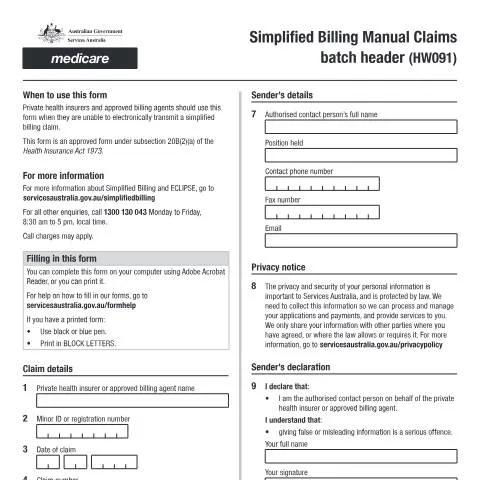
Navigating the Simplified Billing Manual Claims Batch Header Form
In the fast-paced world of healthcare, efficiency is paramount. The Simplified Billing Manual Claims Batch Header Form (HW091), issued by Services Australia, serves as a crucial tool for health professionals navigating the complexities of billing and claiming procedures. Understanding how to effectively utilize this document can streamline the process of submitting claims, thereby ensuring timely reimbursements and reducing administrative burdens.
The Essence of the HW091 Document
The HW091 form is not just a piece of paper; it encapsulates vital information and operational guidelines for health professionals submitting claims to Services Australia. This document is designed specifically for manual claims batch processing. It is a foundational element in the healthcare billing landscape that alleviates many common hurdles faced by practitioners.
Key Features of the HW091
- Batch Submission: The form allows for the submission of multiple claims in a single batch, which can significantly reduce processing time.
- Standardized Format: It provides a consistent structure and format, ensuring that all necessary information is captured accurately.
- Streamlined Communication: Facilitates better communication between health professionals and Services Australia, helping to minimize misunderstandings and errors.
Step-by-Step Utilization of the HW091
When it comes to utilizing the HW091 form, following a structured approach can enhance efficiency and accuracy in the claims process. Here’s a detailed breakdown of how to effectively engage with this document.
Preparation Phase
- Gather Patient Information: Collect all relevant patient data, including Medicare numbers, dates of service, and specific healthcare services provided.
- Verify Claim Details: Ensure all billing information adheres to the latest guidelines set forth by Services Australia to avoid claim rejections.
Completing the Form
While the HW091 is straightforward, attention to detail is imperative. Each section of the form must be meticulously filled out to ensure that it meets the submission criteria.
- Fill in Batch Header Information: The header includes crucial details that help identify the batch and its contents, such as the provider's details and claim totals.
- Attach Supporting Documentation: Although the HW091 itself is not a claim, it must accompany all relevant claim forms and documentation pertaining to the services rendered.
Avoiding Common Misinterpretations
Misinterpretation of the HW091 can lead to significant delays in claim processing or, worse, denials. Here are some common pitfalls to watch for:
Misunderstanding Submission Requirements
- Inaccurate Data Entry: Ensure that all patient and service details are correctly entered as they appear in official records.
- Failure to Include Required Attachments: Submitting the HW091 without the necessary support documents can result in claim rejections.
Identifying Your Audience and Contexts for Use
The HW091 is indispensable for various stakeholders in the healthcare sector, particularly:
- Private Practitioners: Individual health professionals or small practices that submit claims on behalf of their patients.
- Large Healthcare Facilities: Hospitals and medical centers that handle multiple claims simultaneously.
- Billing Agents: Outsourced billing services that submit claims on behalf of healthcare providers.
Specific Situations Requiring the HW091
The HW091 becomes particularly critical in the following scenarios:
- When dealing with batch claims for multiple patients within a specified period.
- In instances where providers need to cross-reference claims with different service codes.
- During audits or reviews when detailed documentation is necessary to justify claims.
Procedural Questions and Clarifications
As with any administrative process, questions often arise regarding the HW091 form. Here are some frequently encountered inquiries:
How to Handle Claim Denials?
In the event of a claim denial, it is crucial to:
- Review the denial reason provided by Services Australia.
- Gather any necessary documentation to support your case.
- Consider submitting a reassessment request if you believe the claim was valid.
Linking the HW091 with Other Necessary Documentation
The HW091 is not a standalone document but is part of a broader ecosystem of claim management. Understanding its relationship with other forms can enhance your billing process.
Related Documentation
| Document Name | Purpose | Relation to HW091 |
|---|---|---|
| Claim Form (e.g., MBS form) | Details specific services provided to the patient. | Must accompany HW091 for batch submissions. |
| Medicare Card Copies | Proof of patient eligibility for Medicare services. | Required for validation of claims listed on HW091. |
| Provider Agreement Documentation | Confirms the provider's eligibility to claim through Medicare. | Establishes legitimacy for claims submitted using HW091. |
Maximizing Efficiency in Claims Submission
To ensure the smoothest possible claims process using the HW091, consider implementing the following best practices:
Regular Updates and Training
Stay informed about changes to billing practices and updates from Services Australia. Regular training sessions for staff can help in maintaining accuracy and compliance.
Utilization of Technology
Employ automated systems where possible to track claims and manage documentation efficiently. Many practices find that integrating software solutions can save time and reduce errors in the claims process.
Final Insights on Navigating the HW091
Successfully utilizing the HW091 form requires a blend of attention to detail, strategic planning, and ongoing education about the claims process. By mastering this document and understanding its context within the broader billing landscape, health professionals can not only enhance their practice's financial health but also ensure that patients receive timely access to their entitled services.
Understanding the Simplified Billing Process for Manual Claims
The Simplified Billing process is designed to streamline the way health professionals can claim Medicare benefits for eligible services rendered to patients. The Manual Claims Batch Header Form (HW091) plays a crucial role in this process. It allows healthcare providers to submit multiple claims in one batch, reducing the administrative burden associated with individual claims. This section will delve into the specifics of this process, including eligibility requirements, types of services that can be claimed, and how to ensure accuracy in your submissions.
Firstly, to use the HW091 form effectively, health practitioners must ensure that they are registered with Medicare and have a valid provider number. This registration confirms that they are authorized to provide services covered under Medicare. Eligible service types include GP consultations, specialist visits, and certain allied health services, provided they adhere to Medicare guidelines. Claiming for services outside of these guidelines may result in rejections. Therefore, practitioners should always be informed about the latest updates to Medicare’s billing policies.
When filling out the HW091 form, accuracy is paramount. Each claim must detail the service provided, the patient's Medicare number, and the corresponding item numbers. Mishaps in this area can lead to delays in processing, or worse, rejected claims. To mitigate these risks, practitioners should consider implementing a double-check system, ideally involving administrative staff who are well-versed in Medicare billing procedures. Additionally, investing in training sessions for staff on the latest Medicare billing updates can greatly enhance claim accuracy.
Common Challenges Encountered with HW091 and Solutions
While the HW091 form simplifies the billing process, health practitioners often encounter various challenges when utilizing this batch header form. Understanding these challenges and their potential solutions is essential for ensuring a smooth claims experience.
One common issue is the rejection of claims due to incorrect item numbers. This can arise when services rendered do not align with the codes submitted. A proactive solution is to maintain an updated reference of item numbers and their corresponding services. Medicare updates these codes periodically, so staying informed about the latest changes is vital. In addition, many software systems that facilitate billing can generate prompts to prevent incorrect submissions.
Another frequent challenge involves the submission of claims for patients without valid Medicare numbers. This situation can lead to unnecessary delays in payment. To avoid this problem, practitioners should verify Medicare numbers at every appointment and ensure that patients are informed about the importance of keeping their details up-to-date with Medicare. This verification can be done through the myGov platform or directly with Services Australia.
Lastly, some practitioners face difficulties due to the complexity of batch submissions. The HW091 form requires a specific format, and failure to adhere to it can result in entire batches being rejected. It is advisable for practices to standardize their submission process, possibly creating a checklist for staff to follow when preparing batch claims. Training sessions focused specifically on these processes can further minimize errors and enhance overall efficiency.
Future Considerations for Medicare Billing Practices
As technology continues to evolve, so too will the methods and formats for submitting Medicare claims. Healthcare providers must stay ahead of these changes to ensure that their billing practices remain efficient and compliant.
One significant trend is the increasing shift towards digital submissions. While the HW091 form is currently a staple for manual claims, there is growing momentum towards fully digital solutions that can streamline the process further. Practitioners should consider investing in software that integrates with myGov, which would allow for real-time updates and processing of claims. This transition can help reduce the administrative workload and speed up payment times.
Moreover, understanding potential changes to legislation affecting Medicare claims is crucial. The recent adjustments to healthcare funding and policies highlight the need for practitioners to stay informed about governmental decisions that could impact billing practices. Engaging with professional associations or forums can provide valuable insights into upcoming changes and help practitioners prepare accordingly.
Lastly, there is an increasing focus on patient-centered care, which may influence billing practices. As patient preferences evolve, healthcare providers may need to adapt their services and, consequently, their billing methods. Staying abreast of these trends will allow practitioners to not only comply with Medicare requirements but also enhance the overall patient experience.