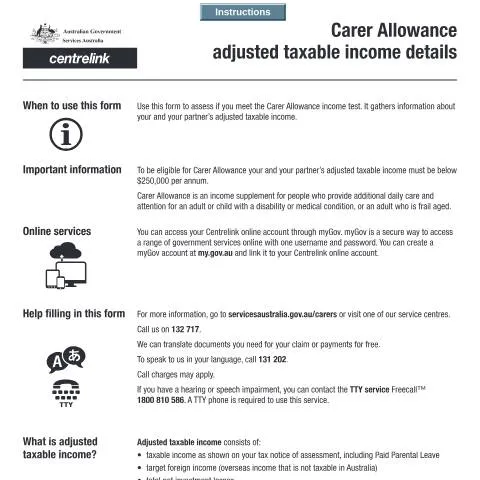
Navigating the Carer Allowance Adjusted Taxable Income Details Form
For many Australians, the responsibilities of caring for a loved one can be overwhelming, both emotionally and financially. The Carer Allowance is designed to offer some financial relief to those who provide daily care to individuals with a disability, chronic illness, or frailty. However, navigating the application process can be intricate, particularly when it comes to understanding the SA489 form, titled Carer Allowance adjusted taxable income details. This document plays a pivotal role in determining your eligibility for the allowance and ensuring your financial details are accurate and up-to-date.
Understanding the Context of the SA489 Form
The SA489 form is not an isolated document but rather a critical component in the broader framework of Services Australia’s support systems. It is primarily used to report your adjusted taxable income, which is essential for assessing your entitlement to the Carer Allowance. This form is particularly important during the annual review of your income, which affects your ongoing payments.
- Purpose: The SA489 form is utilized to declare your taxable income, ensuring that the Carer Allowance is administered fairly and accurately.
- Periodicity: It is typically required on an annual basis, aligning with the financial year in Australia, which runs from 1 July to 30 June.
Who Needs to Complete the SA489?
Understanding who is required to submit the SA489 is crucial. This form is intended for individuals who are currently receiving the Carer Allowance or those who wish to apply for it. The requirements can vary based on unique circumstances, so let’s break down the profiles of individuals who might need to use this form.
Typical Scenarios Requiring SA489 Submission
- Full-time Carers: Individuals providing full-time care to someone with a disability or chronic illness.
- Part-time Carers: Those who may be caring part-time but still qualify for the Carer Allowance.
- Living Situation: Carers living with the person they are caring for, which may affect their taxable income.
Exceptions and Special Cases
There are certain exceptions and unique situations where the completion of the SA489 may vary:
- Income Thresholds: If your income exceeds the threshold set by Services Australia, you may not need to submit this form.
- Temporary Absences: Carers temporarily absent from their caring role due to illness or other circumstances may also have different reporting requirements.
- Overseas Carers: Those who are caring for individuals living outside of Australia may have distinct forms and processes to follow.
The Role of the SA489 in the Carer Allowance Process
The submission of the SA489 form is integral to maintaining your Carer Allowance. Specifically, it ensures that the Department of Services Australia has the correct and current information concerning your income, which dictates your ongoing eligibility for financial support. This form serves to:
- Verify Income: Validate the income reported against your Tax File Number (TFN).
- Assess Ongoing Eligibility: Help determine your eligibility for continued Carer Allowance payments.
- Adjust Payments: Allow Services Australia to adjust your payments if your financial situation changes.
Step-by-Step Guide to Completing the SA489
Filling out the SA489 form can seem daunting, but breaking it down into manageable steps can make the process easier. Here’s a structured guide to help you through:
1. Gather Required Documents
Before you start filling out the form, ensure you have the following documents at hand:
- Your most recent tax return or notice of assessment.
- Any documents indicating additional income sources, such as bank statements or payslips.
- Your Tax File Number (TFN), which is crucial for accurate reporting.
2. Filling Out the Form
The SA489 form consists of several sections that require specific information:
- Personal Details: Input your name, address, and TFN accurately.
- Income Details: Report your adjusted taxable income from your most recent assessment.
- Other Income: Include any additional sources of income that may affect your eligibility.
3. Review and Submission
Once you have completed the form, it is essential to review all entries for accuracy. Incorrect information can lead to delays or issues with your payments. After ensuring everything is correct, submit the form through your myGov account or as instructed by Services Australia.
Consequences of Not Submitting the SA489
Failing to submit the SA489 form or providing incorrect information can have significant repercussions. Here’s what you need to be aware of:
- Payment Delays: Incomplete forms can lead to delays in receiving your Carer Allowance payments.
- Overpayments: If your income is not accurately reported, you may be overpaid, leading to potential debt recovery actions by Services Australia.
- Loss of Eligibility: Continuous failure to report your income may lead to loss of the Carer Allowance altogether.
Tracking Your SA489 Submission and Follow-Up Actions
Once you have submitted the SA489 form, it is wise to keep track of your submission. Here are some practical tips:
Monitoring Your Application Status
- Log in to your myGov account regularly to check for updates regarding your submission.
- If you encounter delays, consider reaching out to Services Australia through their contact channels for clarification.
What to Do If Your Circumstances Change
If there are changes in your financial situation or your caring responsibilities, it is imperative to report these changes immediately. This can include changes in:
- Your income level.
- Your caring responsibilities.
- Your living situation.
Adjusting your Carer Allowance accordingly is crucial to ensuring compliance with Services Australia regulations.
Distinguishing the SA489 from Similar Forms
Many individuals may confuse the SA489 with other forms related to financial support and allowances. It's essential to understand how the SA489 differs from similar documents:
| Form Name | Purpose | Who Should Use It |
|---|---|---|
| SA489 - Carer Allowance Adjusted Taxable Income Details | To report adjusted taxable income for Carer Allowance eligibility. | Current or prospective Carer Allowance recipients. |
| SA500 - Carer Payment Income Test Form | To assess income for Carer Payment eligibility. | Individuals applying for Carer Payment. |
| SA434 - Child Care Subsidy Income Report | To declare income for eligibility for child care support. | Parents or guardians applying for child care allowance. |
Real-World Implications of the SA489 Completion
Ultimately, the completion of the SA489 form is not merely a bureaucratic exercise; it has tangible effects on the financial wellbeing of carers in Australia. By ensuring accurate reporting of your adjusted taxable income, you play a significant role in securing vital financial support that can alleviate some of the burdens of caregiving.
Moreover, understanding the importance of this form creates a foundation for better financial planning. It allows you to anticipate changes in your payments or eligibility and empowers you to make informed decisions regarding your caregiving responsibilities.
Final Thoughts on Engaging with Services Australia
Engaging with Services Australia can be a complex process, but by mastering the SA489 form and understanding its role, you can navigate the system more effectively. Keep abreast of your income situation, remain proactive in reporting changes, and utilize available resources to aid in your application process. Ultimately, being informed is your best ally in securing the support you need.
Understanding the Carer Allowance: Eligibility and Income Assessment
The Carer Allowance is a government initiative designed to provide financial support to individuals who care for a person with a disability or a medical condition. To qualify for this allowance, applicants must meet several criteria regarding their caring responsibilities and the income assessment process. One pivotal aspect that influences eligibility is the concept of adjusted taxable income (ATI).
Your adjusted taxable income is a crucial figure used not just for Carer Allowance, but for other government payments as well. It includes your taxable income plus certain amounts, such as tax-free pensions and benefits, and any salary sacrificed into superannuation. It’s vital to understand how these components are calculated, as they can significantly affect your entitlement.
To determine your eligibility for the Carer Allowance, the Department of Human Services (DHS) examines your adjusted taxable income over a specified period, typically the previous financial year (1 July – 30 June). Keep in mind that the threshold for eligibility can change annually, so staying informed about current limits is essential. For example, if your ATI exceeds the threshold set by the government, you may not qualify for the allowance, or the amount may be reduced.
Income Calculations and Reporting Requirements
When applying for the Carer Allowance, it’s necessary to provide comprehensive information regarding your income. This is where understanding the nuances of income calculations becomes essential. The ATO defines what constitutes income, and it can differ from what you might expect in everyday terms. Generally, your income will include wages, business income, and any other earnings received during the assessment period.
However, certain deductions and adjustments are allowed. For instance, any allowable business expenses can be deducted from your gross income if you are self-employed, thus reducing your ATI. It’s crucial to keep meticulous records of all income sources and any applicable deductions, as you will need to report them accurately when completing your application or during any reviews or audits.
Additionally, you may be required to submit detailed income documentation. This could involve providing payslips, tax returns, or income statements from your employer, each reflecting your earnings accurately. The DHS may also request this information periodically to verify ongoing eligibility for the Carer Allowance.
Appealing Carer Allowance Decisions: Your Rights and Options
If your application for the Carer Allowance is denied or if you receive a decision regarding your entitlement that you disagree with, you have the right to appeal. The path for appeals is governed by the Administrative Decisions (Judicial Review) Act 1977 (Cth), which ensures that individuals can seek a merits review of decisions made by the Department of Human Services.
To initiate an appeal, you must first seek an internal review through the DHS. This process entails requesting a reconsideration of your application based on the reasons provided in the initial decision. The internal review usually involves a different officer who will reassess your case and may take into account additional information that was not previously considered.
If you are still dissatisfied with the outcome of the internal review, you can escalate your appeal to the Administrative Appeals Tribunal (AAT). The AAT provides a more formal setting for your case to be presented, and you will have the opportunity to submit new evidence, such as updated financial information or changes in your caring circumstances. It’s advisable to seek legal advice or assistance from community legal services when preparing for an AAT hearing, as the process can be complex.
Keep in mind that there are strict timeframes for lodging appeals, so it’s essential to act promptly if you decide to contest a decision regarding your Carer Allowance. The specific time limit can vary, but it’s typically within 13 weeks of receiving the initial decision from the DHS.