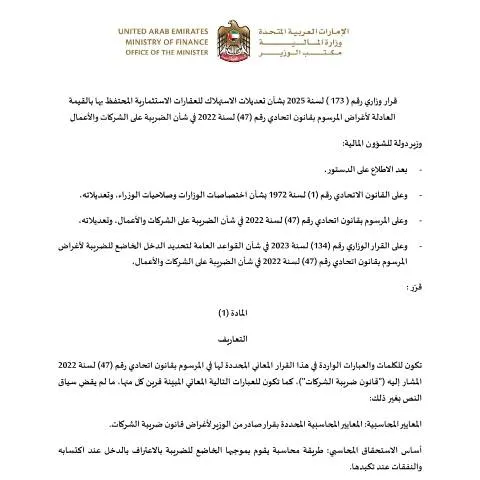
Overview of Ministerial Decision No. 173 of 2025 on Amendments to Depreciation for Investment Properties Held at Fair Value
The Ministry of Finance in the United Arab Emirates has issued Ministerial Decision No. 173 of 2025, which introduces significant amendments to the depreciation policies applicable to investment properties held at fair value. This decision aims to refine the taxation framework for corporate and business entities owning real estate assets, aligning depreciation practices with international standards and ensuring compliance with the provisions of Federal Decree-Law No. 47 of 2022 on Corporate Tax.
Scope and Purpose of the Decision
This ministerial decision primarily targets companies and entities engaged in real estate investment activities within the UAE that hold properties at their fair market value. The amendments are designed to provide clarity and guidance on how depreciation should be accounted for in the context of investment properties, especially those held at fair value rather than historical cost. The overarching goal is to enhance the accuracy of taxable income calculations and promote transparency in the valuation and depreciation processes.
Key Provisions and Changes Introduced
Adjustment of Depreciation Methods for Investment Properties
The decision clarifies the permissible depreciation methods applicable to investment properties held at fair value. It emphasizes the importance of aligning depreciation practices with the property's current fair value, which may differ significantly from its historical acquisition cost. Entities are encouraged to adopt depreciation methods that reflect the asset's usage and economic life, ensuring a realistic representation of its value over time.
Recognition of Fair Value Changes
One of the notable amendments pertains to the treatment of changes in fair value. The decision stipulates that fluctuations in the fair value of investment properties should be recognized in the financial statements according to applicable accounting standards, with corresponding implications for depreciation calculations. This approach ensures that the depreciation expense remains consistent with the property's current valuation, thereby providing a more accurate depiction of the company's financial position.
Implications for Taxable Income
The amendments specify how depreciation adjustments related to fair value changes impact taxable income. Entities are advised to maintain detailed records of valuation adjustments and depreciation calculations to facilitate compliance during tax assessments. The decision underscores the importance of adhering to the guidelines issued by the Federal Tax Authority (FTA) regarding documentation and reporting of property valuations and depreciation.
Impact on Businesses and Real Estate Investors
Businesses involved in real estate investment should review their depreciation policies in light of these amendments to ensure compliance. The decision may result in adjustments to the depreciation expense reported in financial statements and tax returns, potentially affecting taxable income and tax liabilities. It also emphasizes the need for accurate valuation practices, possibly requiring regular property revaluations to reflect current market conditions.
Real estate investors and corporate taxpayers are encouraged to consult with qualified financial and tax advisors to understand how these amendments influence their specific asset holdings. Proper documentation and adherence to the new depreciation standards will be critical in avoiding penalties and ensuring transparent reporting.
Further Guidance and Compliance
The Federal Tax Authority (FTA) and the Ministry of Finance will provide additional guidance and detailed procedures to facilitate the implementation of these amendments. Entities are advised to stay updated through official channels and ensure their accounting and tax practices align with the new requirements.
In conclusion, Ministerial Decision No. 173 of 2025 marks a significant step toward modernizing the depreciation framework for investment properties in the UAE. It underscores the government's commitment to aligning local tax regulations with international best practices while fostering a transparent and efficient taxation environment for real estate investors and corporate entities.