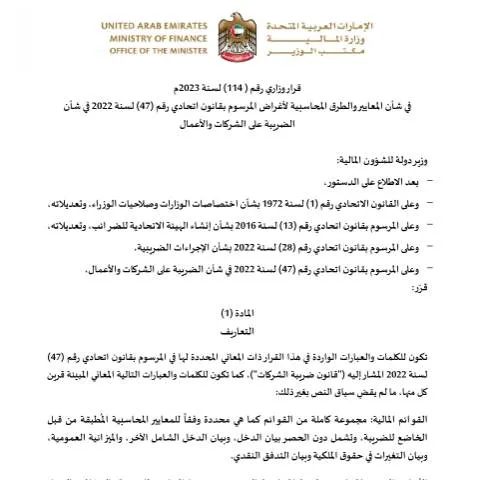
Understanding the Ministerial Decision No. 114 of 2023 on Accounting Standards for Corporate Tax in the UAE
The United Arab Emirates (UAE) continues to enhance its fiscal and regulatory framework to align with international standards and ensure transparency in its tax system. A significant development in this regard is the issuance of Ministerial Decision No. 114 of 2023, which establishes the accounting standards and methods applicable for the purposes of Federal Decree-Law No. 47 of 2022 concerning corporate tax. This guide provides an overview of the decision's scope, its relevance to taxpayers, and the key principles it introduces.
Scope and Legal Context
This ministerial decision is issued by the Federal Tax Authority (FTA) and is part of the broader legal framework governing corporate taxation in the UAE. It aims to specify the accounting procedures and standards that companies must follow to comply with the requirements of the federal corporate tax law. The decision complements existing legal provisions by providing detailed guidance on accounting practices, ensuring consistency and accuracy in financial reporting for tax purposes.
The decision aligns with the UAE’s commitment to adopting internationally recognized accounting standards, facilitating transparency and comparability of financial statements. It also supports the FTA's efforts to streamline tax compliance and enhance the effectiveness of tax administration through clear and standardized accounting procedures.
Who Is Affected by the Decision?
The provisions of Ministerial Decision No. 114 of 2023 apply to all entities subject to corporate tax under the federal law, including but not limited to:
- Resident companies operating within the UAE, regardless of their size or sector
- Foreign entities with taxable presence or income derived from UAE operations
- Branches and permanent establishments of foreign companies
It is essential for these entities to review their current accounting practices and ensure they align with the standards outlined in the decision to maintain compliance and avoid potential penalties.
Key Principles and Requirements
The decision emphasizes the adoption of specific accounting standards and methodologies that facilitate accurate calculation of taxable income. While detailed technical provisions are contained within the decision, some core principles include:
- Alignment with internationally recognized accounting standards, such as IFRS (International Financial Reporting Standards), with adaptations where necessary for tax purposes
- Clear delineation of income and expenses for tax reporting, ensuring proper recognition and measurement
- Guidance on the treatment of specific financial transactions and adjustments relevant to corporate tax calculations
- Procedures for maintaining and documenting accounting records to support tax filings
Adherence to these standards is crucial for accurate tax reporting and for the avoidance of disputes or adjustments during audits conducted by the FTA.
Implementation and Compliance
Entities are encouraged to review their existing accounting systems and practices in light of this decision. It is recommended to consult with professional accountants or auditors familiar with UAE tax law and accounting standards to ensure full compliance.
The FTA is committed to supporting taxpayers through digital channels and online resources, including detailed guides and technical standards, accessible via the official portal. Companies should also stay informed about any updates or clarifications issued by the authority to ensure ongoing compliance.
References and Further Guidance
For comprehensive understanding and detailed requirements, entities should refer to the official documentation issued by the Federal Tax Authority and the relevant legal texts. The FTA’s official website provides access to all updated regulations, technical standards, and procedural guidance necessary for compliance with the UAE’s corporate tax regime.
In conclusion, Ministerial Decision No. 114 of 2023 marks a significant step towards standardizing accounting practices for corporate tax purposes in the UAE. It underscores the country’s dedication to transparency, legal clarity, and alignment with international standards, providing a solid foundation for businesses to operate within a robust fiscal framework.