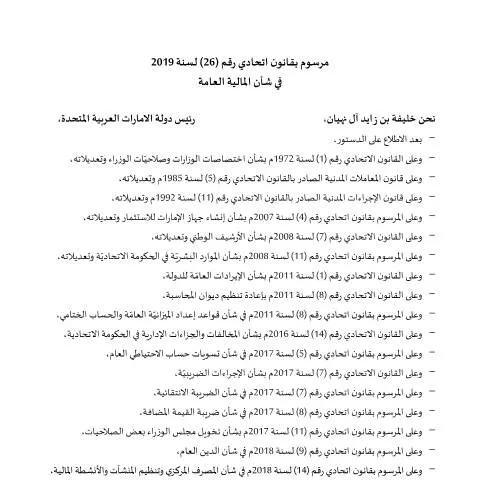
Understanding the Federal Decree-Law No. 26 of 2019 on Public Finance in the United Arab Emirates
The Federal Decree-Law No. 26 of 2019 concerning Public Finance represents a significant legislative framework that governs the management, oversight, and regulation of financial resources within the United Arab Emirates (UAE). As part of the UAE's broader efforts to enhance fiscal discipline, transparency, and efficiency, this law establishes key principles and procedures that impact government entities, public institutions, and other stakeholders involved in the handling of public funds.
Object and Scope of the Law
This decree-law aims to regulate the financial operations of federal and emirate-level entities to ensure sound financial management aligned with the UAE's economic policies. Its primary objectives include establishing clear mechanisms for budgeting, expenditure, revenue collection, and financial reporting, as well as defining the roles and responsibilities of various government bodies involved in public finance.
The law applies broadly across all federal government departments, agencies, and institutions, as well as entities that receive public funding or are engaged in activities related to public finance. It emphasizes the importance of adherence to fiscal discipline and the integration of best practices in financial governance.
Main Provisions and Regulatory Principles
Financial Governance and Oversight
The decree-law mandates the creation of specialized financial oversight bodies responsible for monitoring compliance with established financial regulations. These bodies are tasked with reviewing budgets, expenditures, and financial reports to ensure transparency and accountability.
Budgeting and Financial Planning
It stipulates that all government entities must prepare their budgets in accordance with standard procedures, ensuring alignment with national economic objectives. The law emphasizes the importance of strategic financial planning, including long-term fiscal sustainability considerations.
Revenue and Expenditure Management
The law sets out frameworks for the collection of revenues and the management of public expenditures. It encourages the use of digital tools and electronic systems to enhance efficiency, reduce corruption risks, and facilitate real-time monitoring of financial activities.
Reporting and Transparency
Public entities are required to maintain accurate and comprehensive financial records. Regular financial reports must be prepared and submitted to relevant authorities, fostering transparency and enabling informed decision-making at the federal level.
Implications for Public and Private Stakeholders
The enactment of this decree-law signifies a move towards more disciplined and transparent financial management within the UAE's public sector. For government officials and financial managers, it provides a clear legal framework to guide their operations, emphasizing compliance with established standards and procedures.
For the general public and external stakeholders, the law enhances confidence in the management of public funds by promoting accountability and transparency. It also aligns the UAE’s fiscal policies with international best practices, facilitating economic stability and sustainable development.
Digitalization and Future Developments
In line with the UAE’s national digital transformation strategy, the law encourages the integration of digital platforms and electronic systems in financial management processes. This approach aims to streamline workflows, reduce administrative burdens, and improve the accuracy of financial data.
Ongoing updates and implementations of related regulations are expected to further refine the public finance framework, ensuring adaptability to evolving economic and technological landscapes.
Conclusion
The Federal Decree-Law No. 26 of 2019 on Public Finance underscores the UAE’s commitment to establishing a robust, transparent, and efficient financial management system. Its comprehensive provisions serve as a foundation for sound fiscal governance, supporting the country’s broader economic vision and sustainable development goals. All relevant entities are encouraged to familiarize themselves with its principles to ensure full compliance and contribute to the UAE’s economic stability.