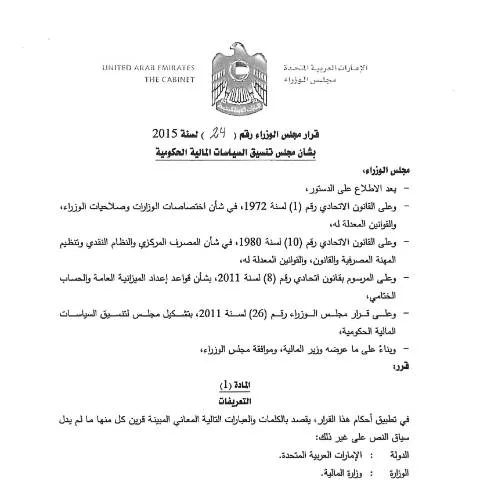
Understanding the Cabinet Resolution No (24) of 2015 on the Government Financial Policy Coordination Council in the UAE
The United Arab Emirates (UAE) has established a comprehensive legal framework to ensure the effective management and coordination of government financial policies. One of the key legislative instruments in this domain is the Cabinet Resolution No (24) of 2015, which pertains to the formation and functions of the Government Financial Policy Coordination Council. This resolution plays a vital role in shaping the financial governance landscape across the federation, emphasizing the importance of coordinated fiscal strategies among various government entities.
Scope and Purpose of the Resolution
The primary aim of Cabinet Resolution No (24) of 2015 is to define the structure, responsibilities, and operational procedures of the Government Financial Policy Coordination Council. The resolution underscores the necessity of a centralized body to oversee the formulation, implementation, and monitoring of financial policies across the UAE’s federal and emirate-level governments. It seeks to promote fiscal discipline, ensure transparency, and facilitate effective resource allocation aligned with national development goals.
This resolution is part of the broader legal framework that supports the UAE’s commitment to maintaining a resilient and sustainable economy. It aligns with the country’s strategic vision of economic diversification and fiscal responsibility, reinforcing the importance of coordinated financial management in achieving these objectives.
Who Is Affected by This Resolution?
The resolution primarily targets government entities involved in financial policy formulation and implementation, including federal ministries, departments, and authorities. It also involves the financial departments of individual emirates, which are encouraged to coordinate with the federal council to ensure policy consistency and synergy.
Furthermore, senior officials responsible for budgeting, financial planning, and fiscal oversight are directly impacted by this resolution. It establishes a framework for collaboration among these stakeholders, fostering a unified approach to managing public funds and financial risks.
Key Provisions and Operational Framework
Formation and Composition of the Council
- The resolution stipulates the formation of the Government Financial Policy Coordination Council, comprising key representatives from federal and emirate-level financial authorities.
- The council’s membership includes senior officials such as the Minister of Finance or his designated representative, alongside other relevant officials from financial departments.
Responsibilities and Functions
- Developing and harmonizing financial policies to ensure consistency across the federation.
- Monitoring the implementation of financial strategies and policies at both federal and emirate levels.
- Facilitating coordination among various government entities to optimize resource utilization.
- Providing guidance and recommendations to enhance fiscal discipline and transparency.
Operational Procedures
- The council convenes regularly, with meetings scheduled to address ongoing financial policy issues and strategic planning.
- Decisions and recommendations are documented and communicated to relevant authorities for implementation.
- The council utilizes digital platforms and official channels to ensure efficient communication and data sharing among stakeholders.
References and Organizational Oversight
This resolution is issued under the authority of the UAE Cabinet, which oversees the development and enforcement of federal laws related to financial management. The Ministry of Finance (MOF) plays a central role in supporting the council’s activities, providing technical expertise, and ensuring compliance with legal standards.
Additionally, the resolution aligns with the broader objectives of the UAE government’s financial policies, which are coordinated through various federal entities and in collaboration with the respective emirate authorities. The resolution emphasizes the importance of a unified approach to fiscal governance, contributing to the country’s economic stability and sustainable development.
Conclusion
Cabinet Resolution No (24) of 2015 represents a significant step towards strengthening financial governance in the UAE. By establishing a dedicated council for policy coordination, the resolution ensures that fiscal strategies are cohesive, transparent, and aligned with national priorities. It exemplifies the UAE’s commitment to digitalization, efficiency, and effective public financial management, serving as a cornerstone for ongoing reforms in the country’s economic landscape.